

If you're running a business in South Asia, you're on the radar. And the attackers aren't amateurs anymore.
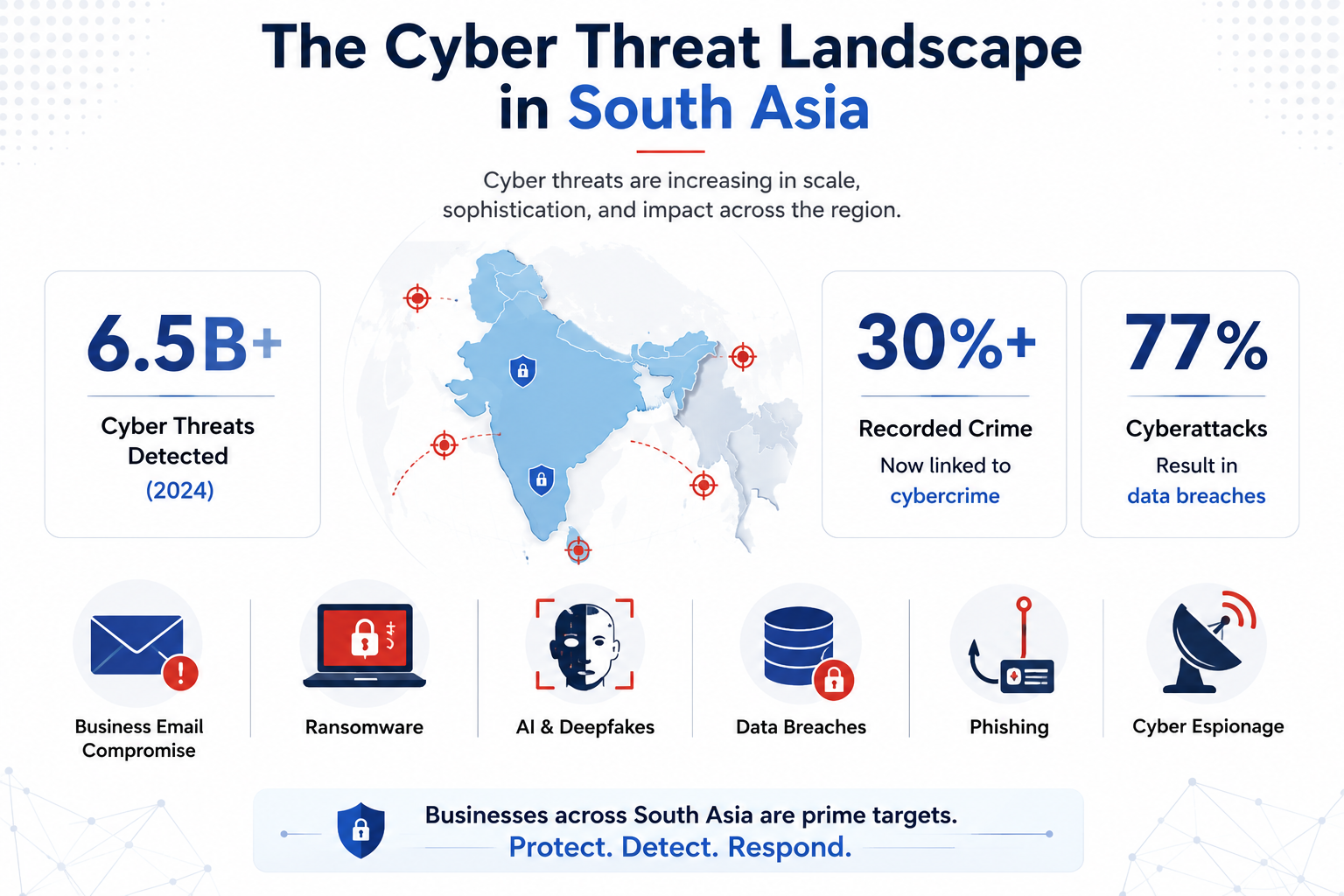
According to INTERPOL, over 6.5 billion cyber threats were detected across Asia and the South Pacific in 2024. Billion. With a B. That's not a number—it's a wake-up call.
The INTERPOL report makes for some pretty uncomfortable reading. Cybercrime now accounts for more than 30% of all recorded crime in over half the countries surveyed. Think about that for a second. Your chances of getting hit by a cyberattack are now on par with-or worse than-getting hit by traditional crime.
Here's what's actually happening on the ground-and why it should worry every business leader in the region.
The Threats That Should Keep You Up at Night
It's tempting to treat cybersecurity as just another item on an IT checklist. But the reality is much broader. Threat actors today operate with impressive coordination-using AI to automate attacks, capitalizing on stolen data, and compromising supply chains. For South Asian companies, these aren't just abstract statistics; they are real operational landmines. Let’s break down the key threats targeting business continuity right now.
Business Email Compromise
BEC has become the most financially destructive cybercrime in South Asia. And it's alarmingly simple.
According to reports, in March 2025, SriLankan Airlines discovered that AED 974,000 (roughly Rs 87 million) had been wired to a fraudulent account. Attackers compromised a supplier's email and altered bank details in what looked like a routine payment instruction.
Same pattern with Sri Lanka's Treasury-they lost $2.5 million through an almost identical BEC attack.
India's seeing the same thing. Dr. Reddy's Laboratories nearly lost Rs 2.16 crore when hackers intercepted email correspondence and sent a fake message from an address resembling the official one.
According to INTERPOL, generative AI is making these attacks far more convincing. Attackers can now clone voices for phone verification and even generate synthetic video of executives authorizing transactions.
Ransomware
Ransomware isn't just about locked files anymore. Attackers exfiltrate data first, then demand payment to decrypt and not leak sensitive information.
According to Cyble's July 2025 report, India and the Asia-Pacific region remain in the crosshairs of global ransomware groups. The Warlock group leaked sensitive data from an India-based manufacturing company-HR records, financial data, and internal repositories.
Thailand, Japan, and Singapore topped the ransomware victim list, followed by India and the Philippines. Critical infrastructure, government agencies, and manufacturing were among the hardest hit.
The Data Breach Economy
According to INTERPOL, 77% of cyberattacks result in data breaches. Stolen data is actively traded on dark web forums. According to Positive Technologies, individual records sell for $20–$100, corporate credentials for $50–$500, and VPN access to critical infrastructure can fetch up to $60,000.
In August 2025, Bangladesh's largest supermarket chain was hit by Qilin ransomware and LockBit 5.0 through phishing emails. Attackers demanded $1.5 million. Although systems were disconnected, in March 2026, over 410 GB of data was leaked on the dark web-customer names, phone numbers, purchase histories, supplier contracts, bank details, and HR documents. The breach exposed personal details of over 4 million registered customers.
Geopolitical Cyber Threats
Some attacks aren't about money-they're about intelligence and regional power dynamics. And businesses get caught in the crossfire.
According to SentinelOne, between January 2025 and January 2026, a threat actor called SloppyLemming conducted an espionage campaign targeting government entities in Pakistan and Bangladesh. Targets included nuclear regulatory bodies, defense logistics, telecommunications, energy utilities, and financial institutions.
Pakistan-affiliated hacker groups launched attacks against Indian targets too. APT36 deployed spear-phishing campaigns targeting Indian government and defense personnel.
According to the Stimson Center, if state-adjacent actors can penetrate government systems, no business should assume they're too small to be a target.
Deepfakes and AI-Powered Crime
According to INTERPOL, deepfake discussions on hacker forums surged 600% between February and June 2024.
In July 2025, scammers used deepfake videos to run over 120 fake investment ads on Facebook and Instagram in India. Meta removed over 23,000 pages and accounts in India and Brazil in March 2025 alone.
According to Indian media reports, a Bengaluru woman was duped of Rs 3.75 crore using an AI-generated deepfake video of a spiritual leader endorsing a fake investment company.
So , this isn't science fiction anymore. It's happening right now.
Phishing and Online Scams
According to INTERPOL, 5.5 out of every 1,000 individuals in the region click on phishing links monthly-roughly twice the global average. Cloud applications are responsible for 28% of these clicks.
What Your Business Actually Needs to Do
Today's cyberattacks aren't random acts of digital vandalism. They're meticulously planned operations run by organized crime syndicates and state-sponsored actors. These groups operate with corporate-like structures, significant funding, and a clear focus on profit or strategic advantage.
For South Asian businesses, the stakes have never been higher. These attacks don't just disrupt IT systems-they hit your bottom line, erode customer confidence, and expose you to regulatory and legal consequences.
From deepfake technology that impersonates senior executives to ransomware groups that weaponize stolen data, the threat landscape is evolving fast. The attackers are professionalizing. Your defenses need to do the same.
Here's where to start. These aren't nice-to-haves.
They're essentials.
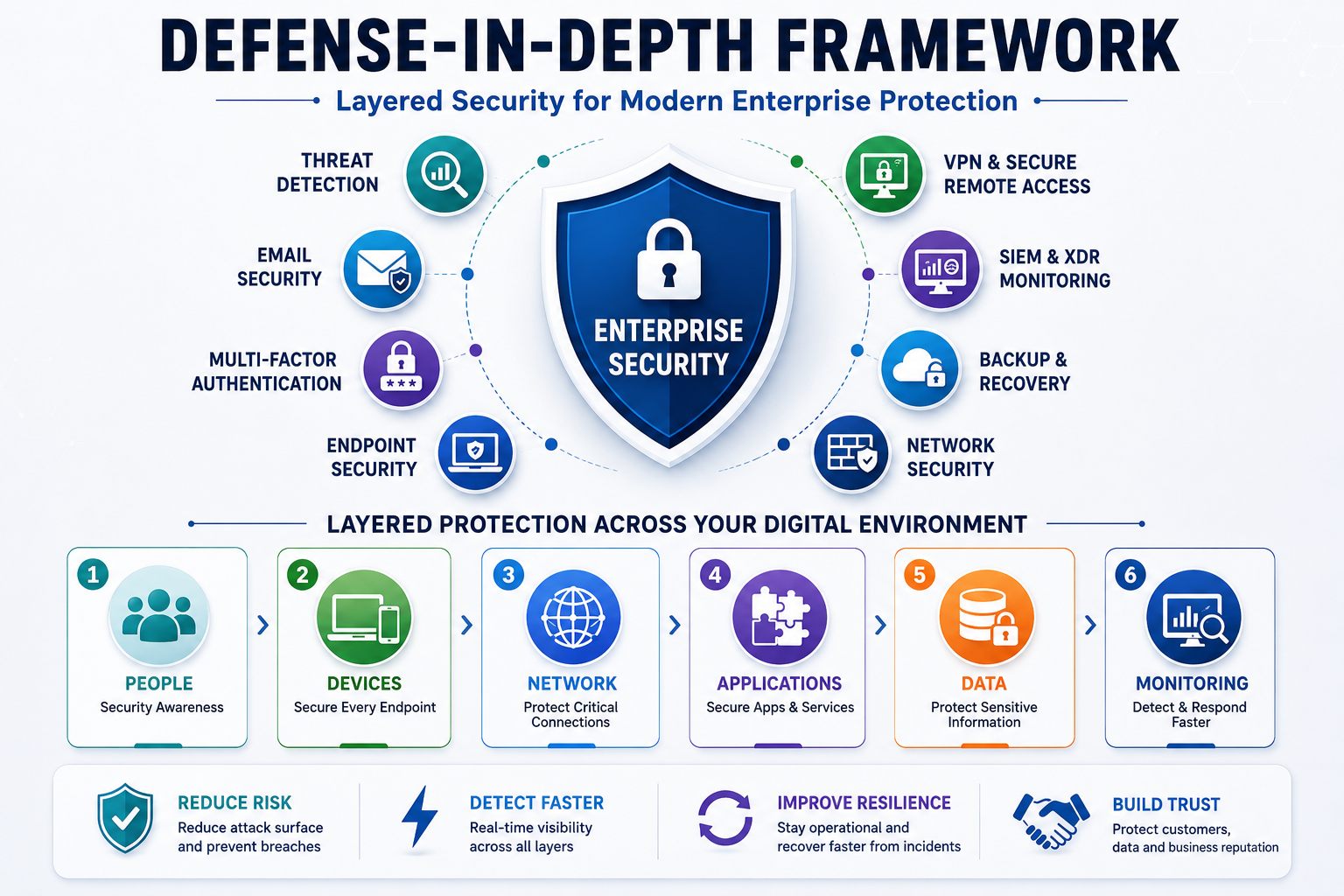
Email Security
Deploy advanced filtering to block spam and phishing.
Sandbox every attachment and link before anyone opens them.
Run simulated phishing campaigns regularly.
Enforce Out-of-Band (OOB) Verification
Remote Access
Disable RDP wherever you don't need it.
Enforce VPN with multi-factor authentication.
Monitor remote access for unusual locations or timing.
Patch Management
Apply OS and software patches regularly.
Prioritize browsers, plugins, and VPNs.
Run vulnerability scans constantly.
Endpoint Protection
Deploy EDR and antivirus on every endpoint.
Restrict lateral movement tools like PsExec and SMB.
Configure detection for encryption behavior.
Access Control
Enforce least privilege. If someone doesn't need access, don't give it.
Limit admin accounts.
Block credential dumping tools like Mimikatz.
Network Segmentation
Keep critical servers separate from user endpoints.
Block lateral movement paths.
Isolate sensitive applications.
Backup and Recovery
Maintain offline, encrypted, immutable backups.
Test recovery processes regularly.
Data Loss Prevention
Detect unauthorized data transfers.
Monitor clipboard and browser data access.
Enforce policies covering data at rest, in motion, and in use.
Browser Security
Disable built-in password storage and autofill.
Enforce password manager usage.
Block malicious browser extensions.
Outbound Network Defense
Deploy DNS filtering and TLS inspection.
Monitor for data exfiltration patterns.
Block suspicious activity immediately.
Threat Detection
Use SIEM and XDR for real-time alerting.
Monitor ransomware-specific indicators.
Use threat intelligence feeds.
Train Your People
Train employees to spot phishing and suspicious emails.
Enforce multi-factor authentication everywhere.
Verify before you click-always check sender identities.
What Bangladeshi Businesses Must Do Now
Bangladesh's rapid digital growth has outpaced its cybersecurity infrastructure. Data breaches are now routine , from e-commerce to telecom, customer data keeps ending up on the dark web. The reason - poor maintenance, outdated systems, and a reactive mindset.
The question isn't if a major attack will hit-it's when.
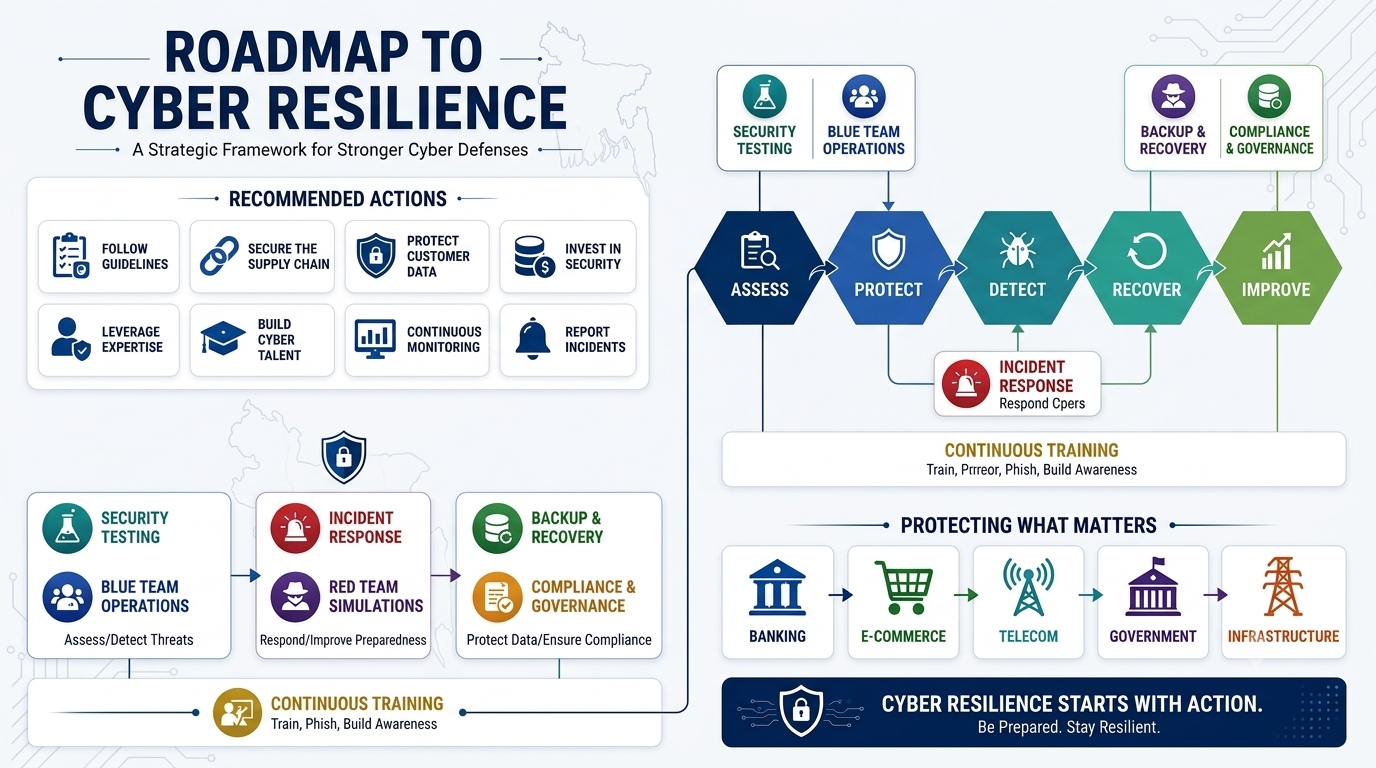
Level up your defenses:
Following the official government and international guidelines are mandatory. Non-compliance is costly.
Secure your supply chain.Your suppliers' failures become your breaches. Audit them Thoroughly. Make security a condition of doing business.
Protect customer data like your business depends on it. Encrypt sensitive information. Restrict access. A breach means fines, sure. But worse,it means losing customer trust. And that's harder to recover than any system.
Invest in security. Many Bangladeshi companies still see cybersecurity as an expense to avoid. That thinking is dangerous. It's not a luxury-it's survival. Allocate real budget to real defenses.
Leverage expertise. Bangladesh now has a growing number of cybersecurity solution providers with experienced professionals.Bring in experts who know the threat landscape and have the tools to defend against it.
Build talent internally. Train your existing team. Send them to courses. Or outsource. But don't leave your systems unprotected because you couldn't find the right people
Report incidents. Inform authorities immediately Silence helps criminals.
Build a Proactive Defense Strategy:
Run regular security testing and penetration tests.
Hire red teams to simulate real attacks.
Build a blue team to monitor and respond 24/7.
Train constantly—one session a year isn't enough.
Create a culture of awareness. Run phishing simulations. Share updates.
BGD e-GOV CIRT warned in 2025 of potential attacks on Critical Information Infrastructures—power, banking, and public services. Attackers are targeting web apps, credentials, and DDoS.
Bangladesh Bank lost $101 million in 2016 due to SWIFT vulnerabilities. Shwapno exposed 4 million customers in 2026 after a ransomware attack. Both could have been prevented with stronger defenses.
Over the past five years, nearly 200,000 complaints have been filed.
Cybersecurity isn't just IT anymore-it's business survival. One attack can destroy years of work.
The Clock is Ticking
The threat landscape is expanding. AI, IoT, and cryptocurrency will play a significant role in future attacks. Your defenses need to keep up.
Many of the South Asian organizations now rank cybersecurity as their top risk-the highest of any Asia Pacific subregion. If you're not treating it as a priority, you're falling behind.
Don't wait for an attack to take action. By then, it's already too late.
Start with one thing today. Review your email security. Run a phishing simulation. Test your backups. Every step counts.