

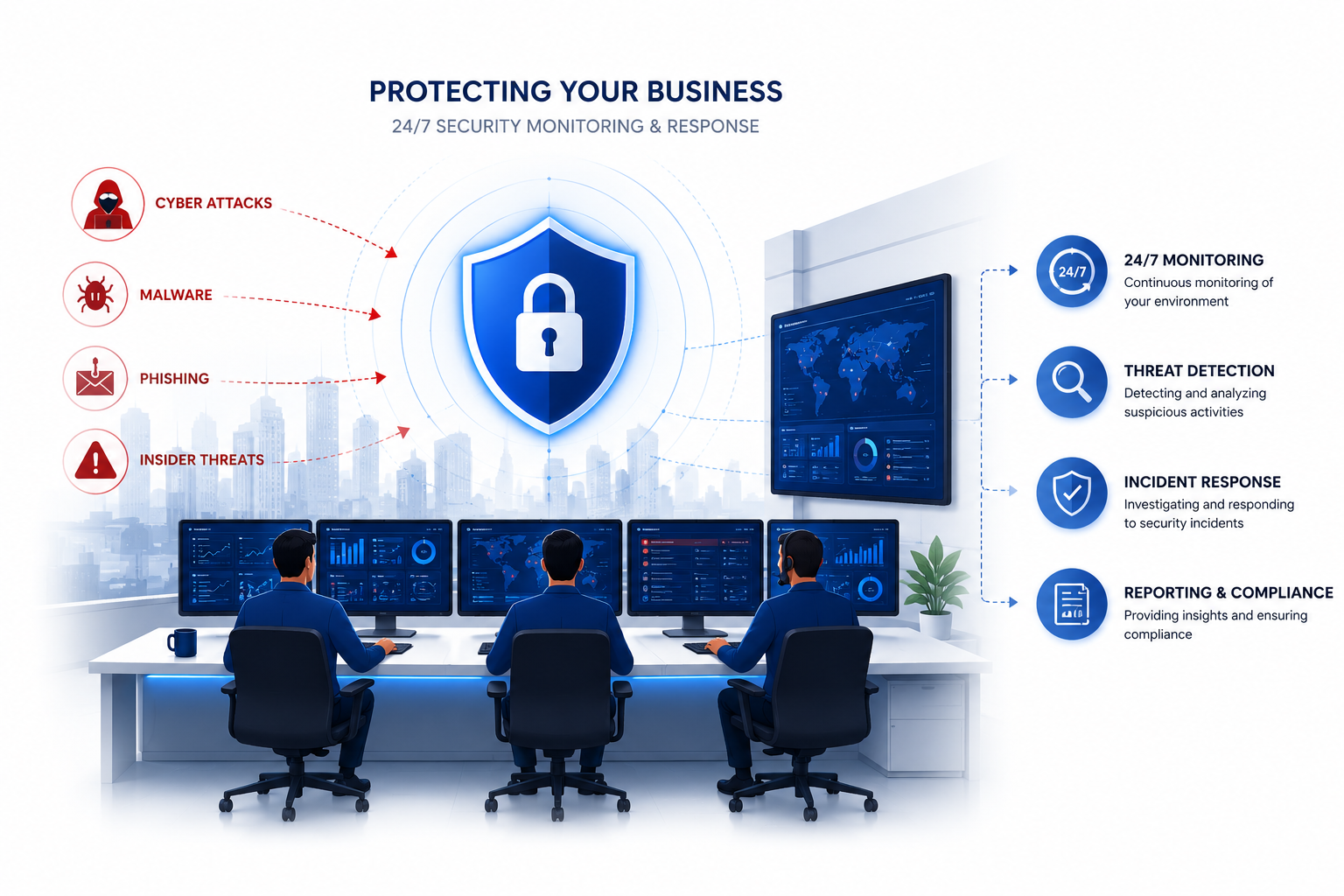
Every modern business invests in cyber security. Firewalls are deployed, antivirus software is configured, and security tools run around the clock, generating alerts whenever suspicious activity is detected.
But a critical question remains: Who investigates those alerts when they appear at 3:00 AM?
Security tools can identify unusual behavior, but they cannot decide whether an alert represents a false positive, a minor policy breach, or an active ransomware attack. Technology detects, but human expertise responds.
Imagine your digital environment as a modern office building. You can install high-end security cameras, motion sensors, and electronic door locks to protect customer data, financial records, and proprietary intellectual property. However, if no security team is actively monitoring those feeds or responding to alarms, the technology alone cannot stop an intruder. Digital security operates on the exact same principle.
A Security Operations Center (SOC) is the dedicated human element—the team responsible for continuously monitoring your network, investigating anomalies, and neutralizing threats before they escalate into business-disrupting incidents, aligning with the NIST Cybersecurity Framework (CSF 2.0) emphasis on continuous detection and response capabilities.
As cyber attacks grow in frequency and sophistication, decision-makers face a pivotal strategic choice: Should you build an Internal SOC, or outsource your security operations to a specialized provider?
Because no single model fits every business, making the right choice requires evaluating your organization’s size, budget, regulatory environment, and desired level of operational control. This guide compares Internal, Outsourced, and Hybrid SOC models across three core business pillars: Cost, Control, and Coverage.
Understanding the Models
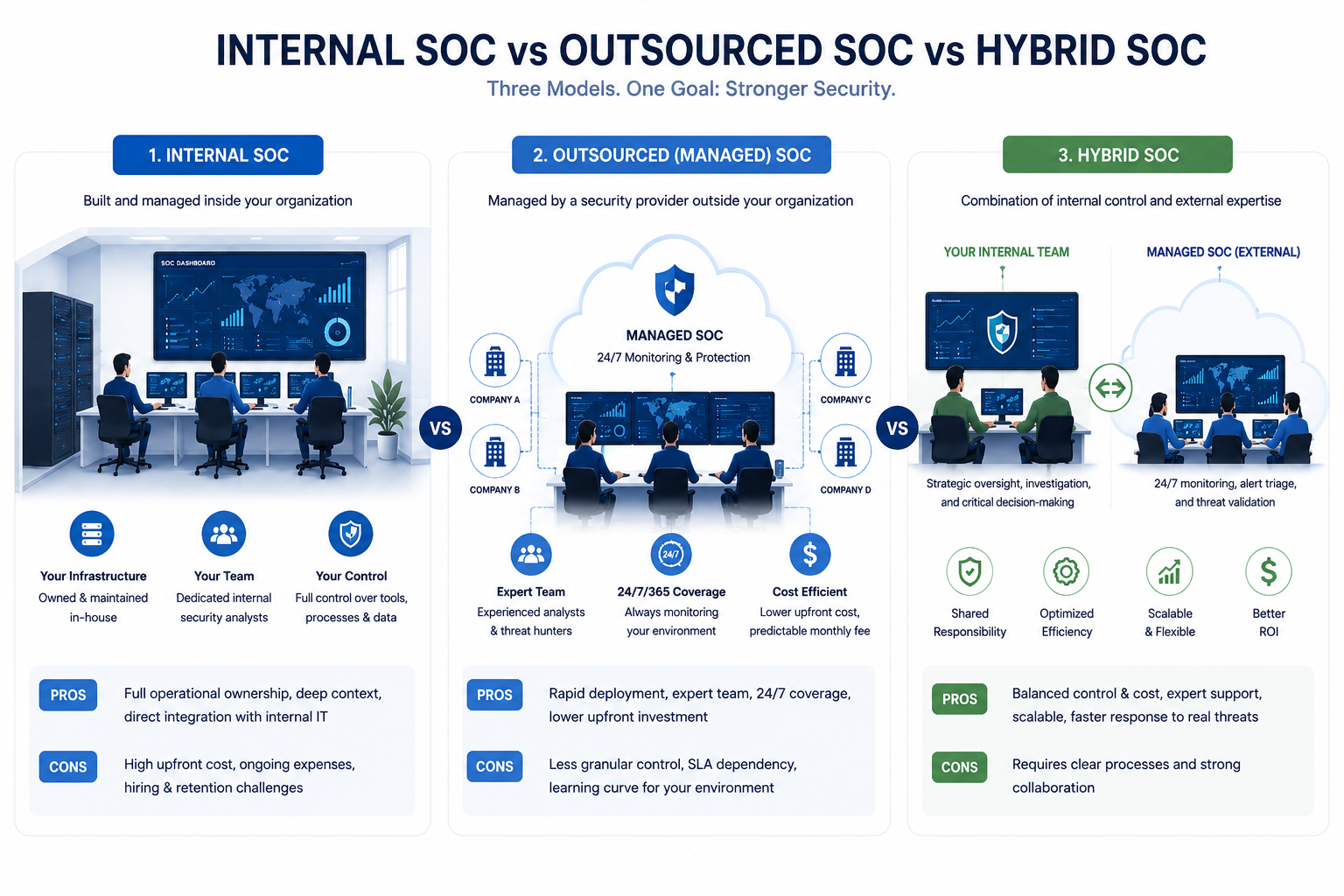
Before evaluating trade-offs, it is essential to define how these operational structures function in practice.
1. Internal SOC
An Internal SOC is a fully dedicated security operations center built, equipped, and managed entirely within your organization.
Instead of relying on third-party services, you recruit your own cybersecurity specialists, establish internal protocols, and procure complex software platforms—such as SIEM (log centralization), EDR (endpoint threat isolation), and SOAR (workflow automation). Your in-house team holds end-to-end responsibility for detecting, investigating, and mitigating cyber threats across your infrastructure.
Pros: Full operational ownership, deep context and familiarity with internal business processes, and seamless integration with your existing IT operations.
Cons: High initial setup costs (CapEx), heavy ongoing operational expenses (OpEx), and continuous challenges in hiring and retaining skilled security personnel.
2. Outsourced (Managed) SOC
An Outsourced SOC transfers day-to-day threat monitoring and initial analysis to a third-party cyber security service provider equipped with specialized infrastructure and round-the-clock staffing.
Instead of building a team from scratch, you leverage an established external team responsible for continuous monitoring, initial threat containment, and compliance reporting. Your internal IT team can then remain focused on core business initiatives while cyber security experts handle baseline defensive operations.
Pros: Rapid deployment, lower upfront capital investment, predictable operational expenses, and immediate 24/7/365 coverage.
Cons: Less granular control over daily procedures, dependency on Service Level Agreements (SLAs), and an initial learning curve for external analysts to understand your environment.
3. The Hybrid SOC: The Modern Enterprise Compromise
Rather than treating this as a binary choice, many organizations are increasingly adopting a Hybrid SOC model to combine continuous monitoring with internal strategic oversight, balancing operational efficiency and organizational control. In this model, an external provider handles round-the-clock operational monitoring and noise reduction, escalating only validated, high-priority threats mapped against standard frameworks like MITRE ATT&CK to an internal team that retains ultimate control over strategic remediation and critical systems.
The Three Pillars: Cost, Control, and Coverage
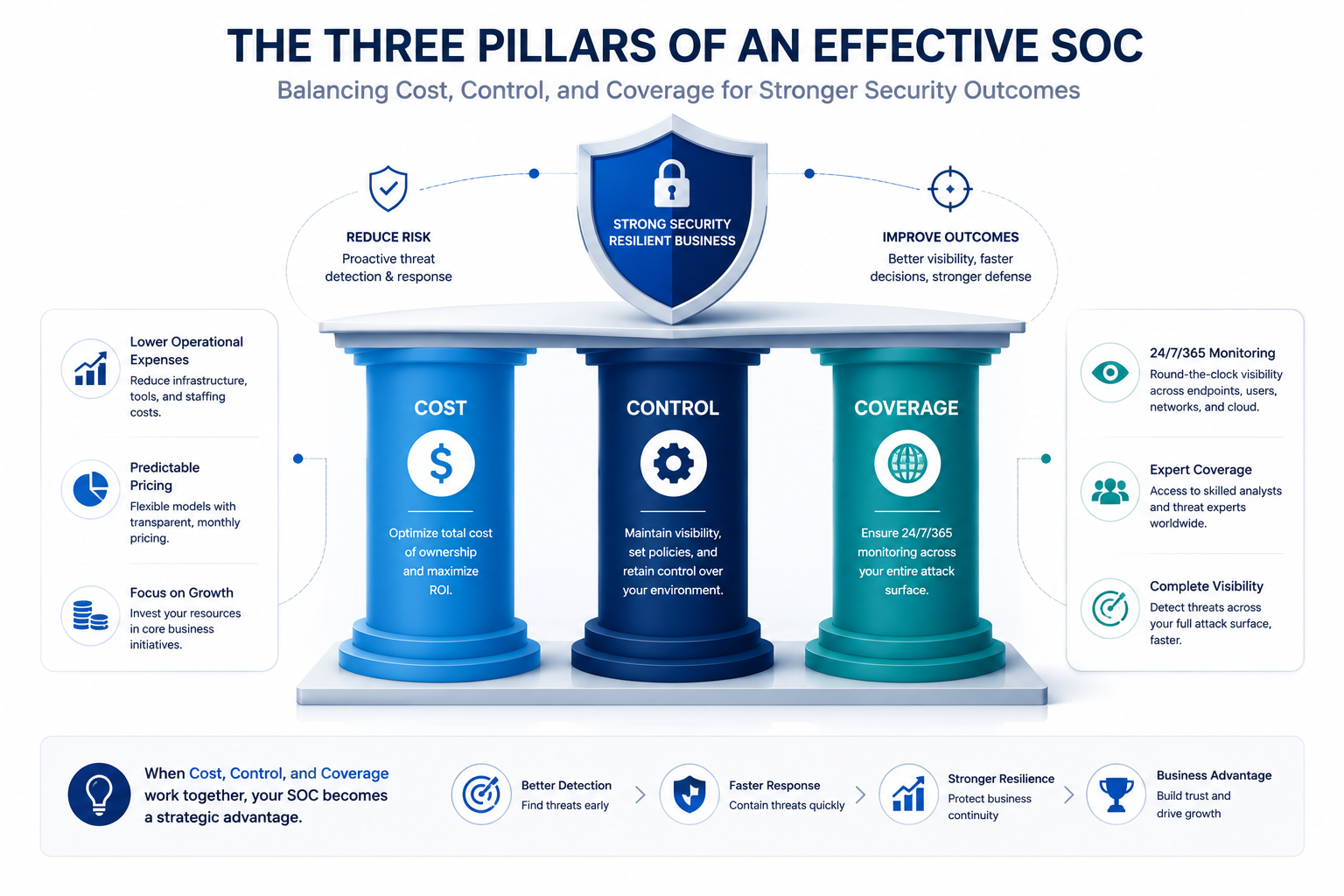
Pillar | Internal SOC | Outsourced SOC | Hybrid SOC |
Cost | High upfront CapEx + continuous OpEx | Low CapEx; predictable recurring OpEx | Balanced, scalable investment |
Control | Absolute ownership over tools & processes | Process-driven; governed by SLAs | Strategic control remains in-house |
Coverage | Constrained by internal staffing budgets | Guaranteed continuous 24/7/365 | 24/7 tier-1 monitoring + internal escalation |
1. Cost: Capital Investment vs. Predictable Subscriptions
Building an internal facility requires purchasing enterprise software licenses, configuring hardware, and maintaining competitive salary packages for at least 5–12 analysts to cover multi-shift 24/7 rotations.
Conversely, an Outsourced or Managed SOC model converts unpredictable capital expenditures into predictable subscription costs. According to the IBM Cost of a Data Breach Report, organizations leveraging managed 24/7 threat detection significantly reduce overall containment costs and breach response times compared to those relying on limited internal coverage.
2. Control: Deep In-House Context vs. External Process Governance
Internal teams possess an innate understanding of business-critical assets, organizational hierarchy, and custom software setups. Outsourced providers rely on structured playbooks and standardized SLA to triage alerts. A Hybrid arrangement bridges this gap: the service provider filters out low-level alert fatigue, giving your internal staff clear, actionable findings on the incidents that matter.
3. Coverage: Overcoming the Talent Shortage
Achieving true 24/7 coverage internally is difficult due to industry-wide talent shortages, high recruitment costs, and analyst burnout from shift work. Outsourced and Hybrid options eliminate single-point-of-failure risks by giving you access to a shared pool of vetted tier-1 to tier-3 security experts immediately.
Market Realities: Regional Challenges & Digital Growth
Digital transformation across emerging and established markets—such as banking, healthcare, telecom, and e-commerce—has vastly expanded organizational attack surfaces. However, building in-house security infrastructure often hits three major bottlenecks:
Scarcity of Local Expertise: Security talent is in high demand worldwide. High turn-over rates and remote international offers make retaining specialized internal staff exceptionally difficult.
Budget Optimization: Allocating significant funds toward proprietary SIEM/SOAR platforms and ongoing operational support often strains annual IT budgets.
Evolving Regulatory Compliance: Regulatory compliance directives—such as the Bangladesh Bank ICT Security Guidelines for financial entities—increasingly mandate explicit log retention, active threat hunting, and rapid incident response times that are difficult to execute on a purely internal setup.
Strategic Framework: Choosing the Right Model
Select the model that best matches your organization's budget maturity, team capability, and regulatory environment:
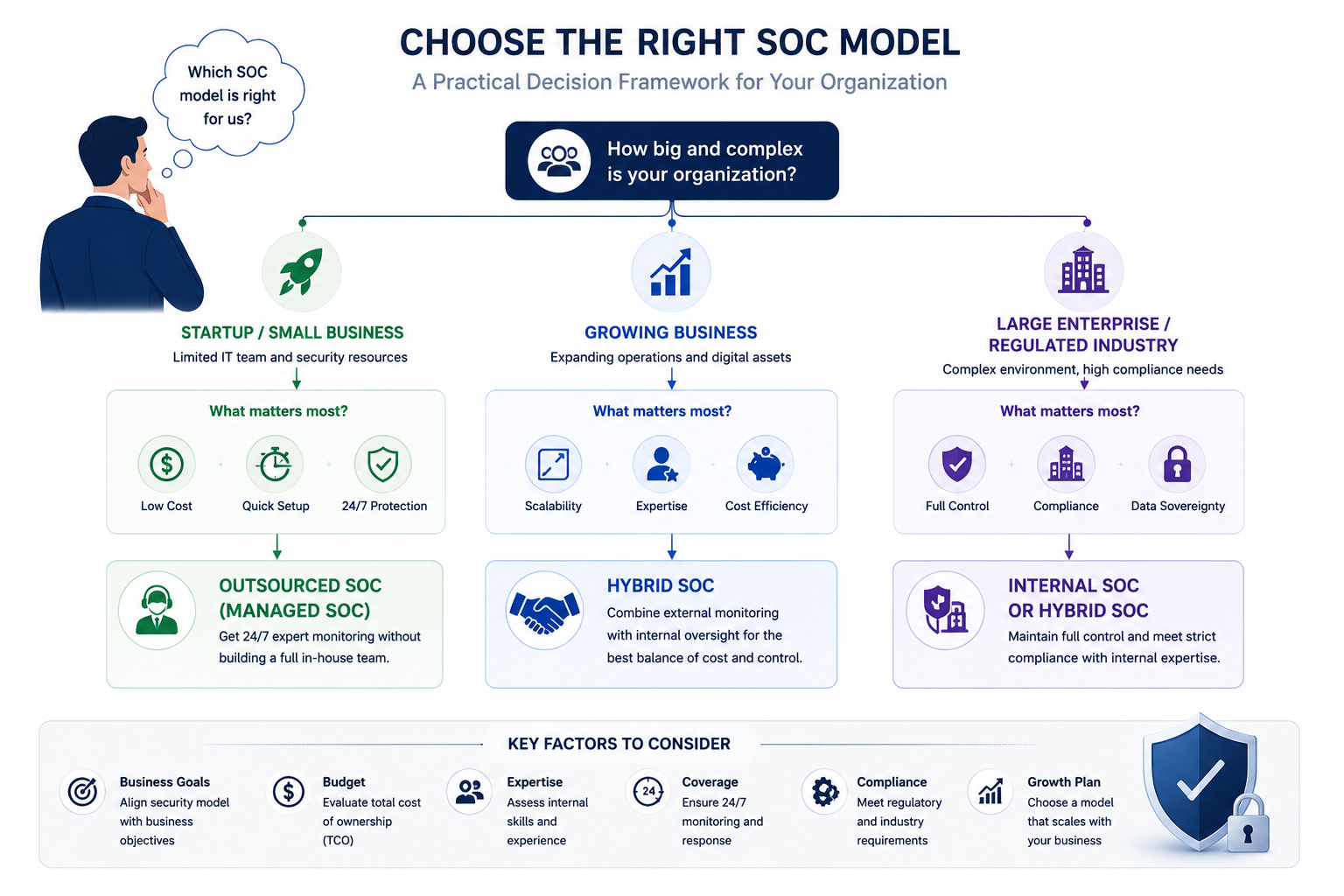
Startups & Small Businesses: An Outsourced SOC delivers fast deployment, low upfront costs, and immediate 24/7 protection without the burden of managing an in-house team.
Growing Businesses: A Hybrid SOC offers the ideal balance of cost efficiency, scalable security expertise, and shared operational control.
Large Enterprises & Regulated Industries: An Internal or Hybrid SOC ensures maximum compliance, strict data sovereignty, and full operational control over critical assets.
How Penough Strengthens Your Security Operations
Building effective security operations doesn't have to mean starting from scratch. Whether you require a fully managed security operation or a hybrid extension to support your existing IT team, Penough Security Operations provides tailored, enterprise-grade capabilities built around your operational needs.
Continuous 24/7 Monitoring: Our dedicated analysts monitor your infrastructure continuously, isolating real threats before they cause operational downtime.
Threat Detection & Incident Response: We validate and investigate incoming alerts, delivering clear containment playbooks directly to your technical teams.
SIEM Optimization: If you already operate a SIEM, we help fine-tune your detection rules and eliminate log noise. If not, we deploy and manage an architecture tailored to your infrastructure.
Seamless Scalability: Expand your monitored endpoints, user accounts, and cloud environments dynamically without restructuring your internal security headcount.
Conclusion
Cyber security is no longer measured by the number of security tools an organization owns—it's measured by how quickly it can detect, investigate, and respond to threats.
Cyber attacks don't wait for business hours, and they rarely give organizations a second chance. Whether you choose an Internal SOC, an Outsourced SOC, or a Hybrid model, the goal remains the same: build a security operation that protects your business, supports your growth, and is ready to respond when it matters most.
The best SOC isn't necessarily the one with the most technology—it's the one that's prepared when the next attack begins.