

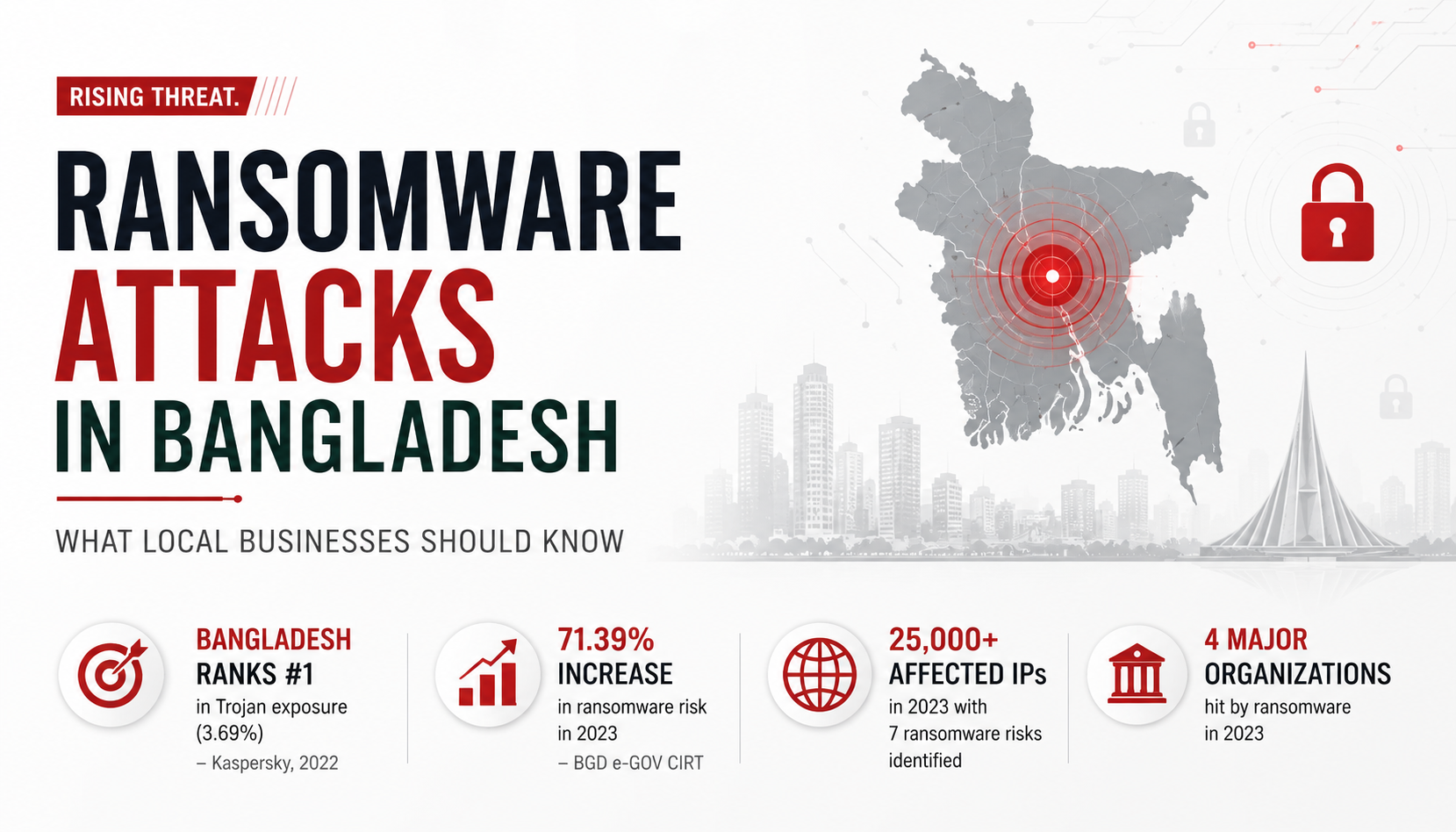
Ransomware has stopped being a foreign news story for Bangladeshi companies. A widely cited 2022 Kaspersky survey placed Bangladesh at the top of the world for the share of users hit by Trojan-family attacks, at 3.69 percent, a figure the country’s own cyber authorities have referenced since. In its most recent public threat analysis, covering 2022 to 2023, BGD e-GOV CIRT, the national Computer Incident Response Team, recorded a 71.39 percent jump in malware activity carrying ransomware risk in 2023 versus the year before, with more than 25,000 affected IP addresses and seven distinct ransomware risks identified. Four major organisations, two of them government bodies, were confirmed ransomware victims within that single year.
These are not abstract figures, and the pattern has not slowed since. In December 2022, a leading pharmaceutical company lost roughly 750 gigabytes of data to the LockBit 3.0 gang. In March 2023, Biman Bangladesh Airlines faced a five-million-dollar ransom demand after 100 gigabytes of operational data was taken hostage; recovery failed and much of it was leaked publicly. Around the same time, Bangladesh Krishi Bank’s core banking system was encrypted by ransomware, forcing an emergency response. Most recently, on July 10, 2026, the Qilin group claimed an attack on Navana Real Estate, a long-established property developer, and is threatening to publish stolen data unless paid. National authorities continue to flag financial services, aviation, pharmaceuticals, and industrial firms as the sectors most exposed.
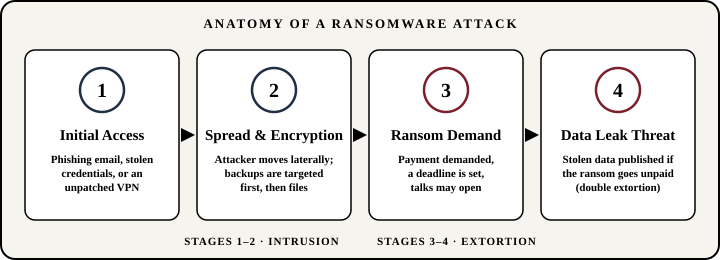
Figure 1. The four-stage anatomy of a typical ransomware attack, from first foothold to public data-leak threat.
Watch the Leak Sites, Not Just the Headlines
The pace shows no sign of slowing anywhere. BlackFog counted 90 publicly disclosed ransomware attacks worldwide in March 2026 alone, with Qilin — the same gang behind the Navana Real Estate case — leading that month with eight claimed attacks. Ransomware gangs now run public leak sites that name victims and post samples of stolen data to pressure payment, and defenders increasingly watch these sites directly rather than waiting for news coverage to catch up.
Ransomware.live is one of the most widely used open trackers: it continuously scrapes ransomware groups’ leak sites and lists newly disclosed victims as they appear, alongside a live map of recent activity. RansomLook runs a comparable open feed, indexing hundreds of active groups and their disclosed victims in a searchable database. Neither tool hosts stolen data itself; both simply index who has been named, and by which gang. Bangladeshi firms, especially in the four sectors flagged above, gain real value from checking these trackers on a regular basis, since appearing there — even briefly — is often the earliest external warning a company gets. Searching your own company name and domain on these trackers costs nothing and takes a few minutes; treating it as a recurring calendar task, not a one-time check, is what turns it into real protection.
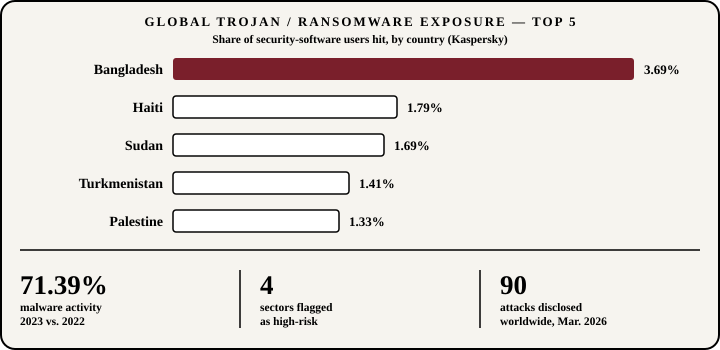
Figure 2. Bangladesh’s rank among the world’s most Trojan-exposed countries, alongside the other figures now shaping local risk (BGD e-GOV CIRT, Kaspersky, BlackFog)
Before an Attack: A Preparation Roadmap
Preparation decides whether an incident becomes a bad week or a company-ending event. The joint #StopRansomware Guide from CISA, the FBI, the NSA, and MS-ISAC sets the baseline: keep offline, encrypted, and regularly tested backups, since most ransomware operators now hunt for and try to destroy connected backups before they even encrypt production data. A practical roadmap for a Bangladeshi SME or mid-size firm builds on that baseline:
Back up on the 3-2-1 principle — three copies, two kinds of media, one kept offline or immutable — and prove it works with real test restores, not just a completed backup job.
Patch internet-facing systems and VPN gateways on a fixed schedule; unpatched remote-access software remains one of the most common doors attackers use.
Turn on multi-factor authentication for email, VPN, and every admin account; stolen or reused passwords sit behind a large share of intrusions.
Segment the network so one compromised laptop cannot reach finance, production, or backup systems directly.
Run short phishing drills and staff briefings; most ransomware still starts with one clicked link or opened attachment.
Put a one-page incident response plan on paper naming who calls BGD e-GOV CIRT, who calls the insurer, and who calls legal counsel — decided before an incident, not during one.
Review cyber insurance terms and vendor or supply-chain access at least once a year; a partner’s weak security can quickly become your incident.
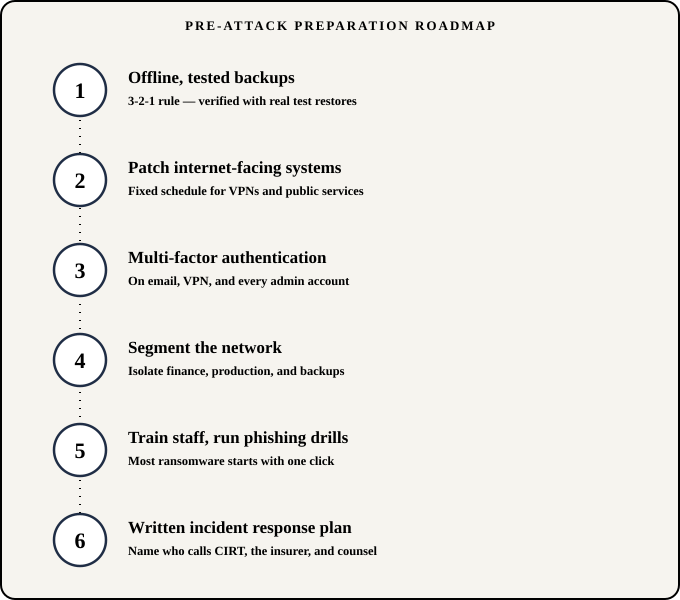
Figure 3. A six-step preparation roadmap businesses can act on before an incident occurs.
After an Attack: Preserve Evidence, Document Everything
The instinct after finding ransomware is to panic, power everything off, and start rebuilding. CISA’s own response guidance argues against that: isolate affected devices from the network immediately, but preserve evidence that is highly volatile in nature, such as system memory, security event logs, and firewall log buffers, before it is overwritten or lost. That single decision — isolate without wiping — is often what separates a recoverable incident from a legal and financial mess.
Take affected systems off the network, not off power; shutting a machine down can erase memory-resident evidence for good.
Export and timestamp firewall, VPN, Active Directory, and endpoint logs covering at least the preceding 30 days.
Photograph the ransom note wherever it appears, and record every affected file path.
Keep a written timeline of who found what, when, and what action was taken, with names attached to each entry.
Restrict access to this material to a small, named group, so it can hold up later as evidence.
Bangladesh’s Cyber Security Ordinance 2025, which took effect in May 2025 and replaced the 2023 Act, places defined reporting obligations on operators of critical information infrastructure. Regardless of sector, BGD e-GOV CIRT and the police Cyber Crime unit should be notified as part of the response, and insurers and legal counsel will expect this documentation before processing a claim or advising on any ransom decision.
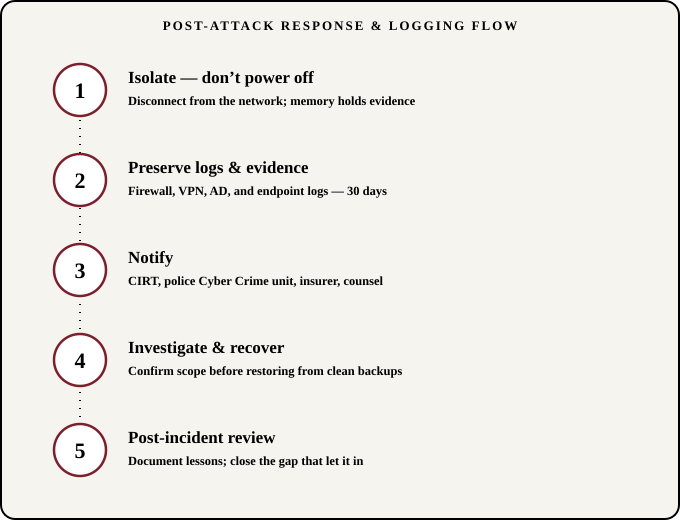
Figure 4. What to do — and document — in the hours immediately after a ransomware incident is discovered.
The Bottom Line
Ransomware in Bangladesh is now a recurring, sector-spanning cost of doing business, not a one-off event that happens to someone else. Companies that treat backups, leak-site monitoring, and log preservation as routine operating procedure, rather than emergency measures improvised after the fact, consistently recover faster and lose less — in money and in reputation — than those that do not. None of this needs a large budget or a large security team; it needs a decision, made in advance, about who does what, with documentation treated as part of the response itself rather than an afterthought once the systems are finally back online.